Residential development · Brașov
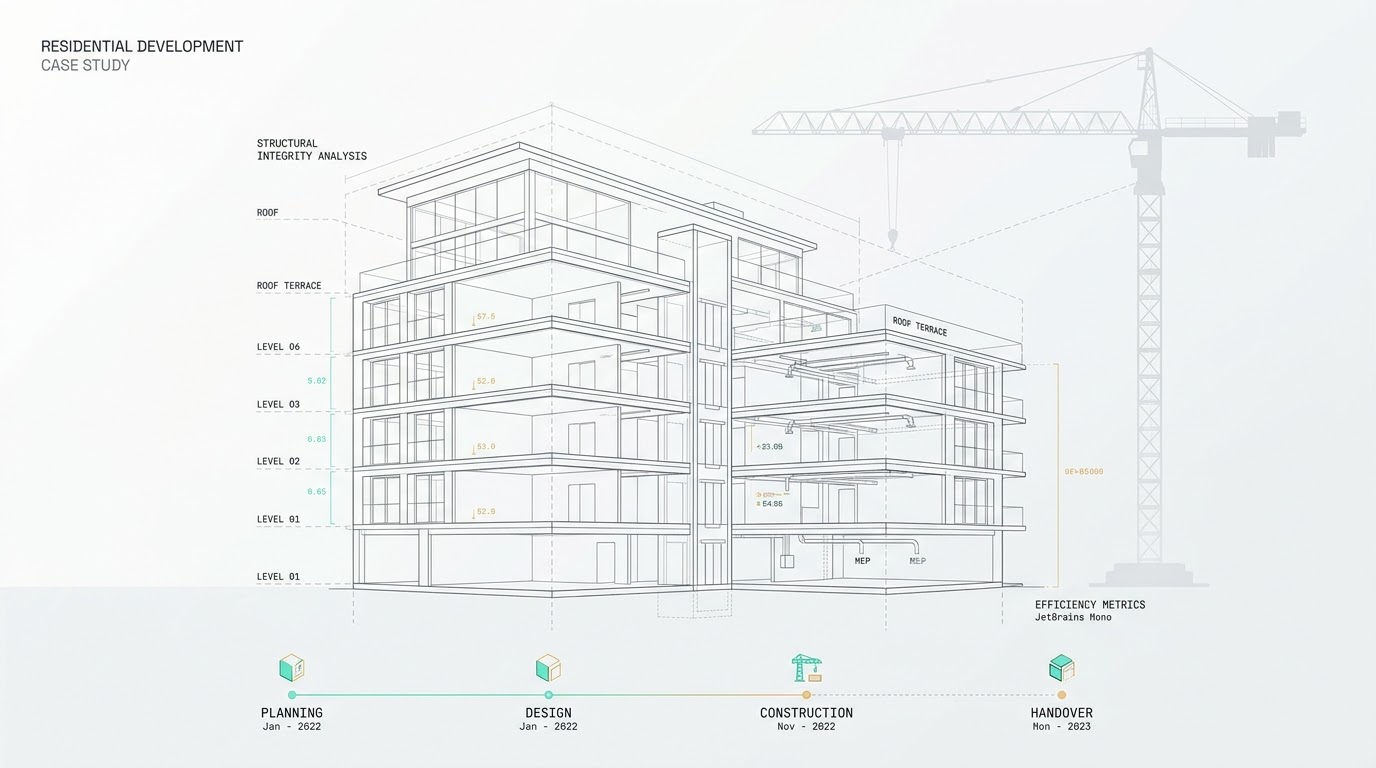
Full lifecycle from land to administration
- Client
- Dynamic Build Invest
- Location
- Brașov
- Completed
- March 2024
- Platform
- Podio, Automation, Integrations
- Services
- Workflow Architecture, Custom Development, Automation, Systems Integration
- 100,000+
- timesheet entries
- 26,000+
- meter readings
- 10,000+
- utility invoices
- 238
- automated workflows
We carry every building from land and permits all the way to handover in one system — and I can see at any moment what a unit costs to build, what it sells for, and where each project stands on budget and profit.
The same system that builds a block then administers it: meter readings become utility invoices on their own, every hour on site ties back to a budget, and payroll runs from the timesheets. Each new development just plugs in — we grow without adding back-office staff.
Capabilities
- land & permits
- construction cost control
- unit sales & contracts
- client handover
- building administration
- QR meter readings
- automatic utility billing
- procurement
- HR & payroll
The challenge
A residential developer carries a building from a plot of land all the way to occupied homes — permits, design, construction, sales, handover, and then years of building administration. Each of those stages usually lives in a different tool (or a different spreadsheet), and none of them talk to each other. Dynamic Build Invest wanted the whole lifecycle — and the whole company — in one place.
What we built
A Podio-based operating system that runs the entire business across roughly seven connected workspaces. One building and one project thread through all of them, carrying a unit from land and permits → design and construction → sale → handover → ongoing administration, on top of a full finance and HR/payroll back office. It’s an end-to-end ERP, not a CRM.
How it fits together
A building (bloc) and a development (proiect) are the spine — nearly every record hangs off them:
- One unit, its whole life. Each apartment, commercial space, office or parking spot is a single record that carries it from available through reservation and sale — with multiple price scenarios (cash, instalments, “Prima Casă”) and Romanian reduced-VAT bands — and then keeps going as the maintenance and utility account once it’s handed over.
- Construction, costed to the task. Every job on site is a work objective with its own labor and material budget, schedule, progress and quality checklist. Procurement orders and supplier invoices flow against it, so budget-versus-actual is live per task, per floor, per phase.
- Permits that can’t lapse. Every urbanism and utility authorization is tracked with its expiry date and chased with tasks before it lapses — because you can’t legally build on an expired permit.
- A live P&L per building and project. Sales, collections, costs and labor roll up into per-building unit economics (realized vs. planned €/m²) and a project-level pro-forma: planned vs. sold vs. collected vs. profit.
- Everything connected. Construction drawings mirror into the permit and site registers; timesheets tie each worker-day to an objective and cost center so labor cost reconciles against project profit; the developer’s admin and the building-administration workspace keep clients in sync.
Automation doing the heavy lifting
238 automated workflows and ~47 custom integrations take the repetitive work off the team:
- Meter reading → utility bill → collection, untouched. Each apartment’s water, gas and electricity meters are read (QR-based), consumption is computed against the previous reading and validated for anomalies, then maintenance and utility invoices are generated, rendered as fiscal PDFs, sent by email and SMS, and tracked all the way to payment.
- Sale → contract, automatically. Marking a unit sold creates its sale-purchase contract record and kicks off the legal registration.
- Procurement & site costs. Branded purchase orders go out to suppliers, supplier invoices become cost-center- and phase-tagged expenses, and goods-handover protocols are generated — all against the right construction objective.
- HR & payroll, end to end. Daily timesheets are generated for active staff and synced master↔site with overtime; payroll runs for office and site staff (monthly or hourly), nets advances, and one click posts the cost per cost center and marks salaries paid. Compliance jobs chase work-contract and occupational-medicine expiries and flip employee status on leave start and end.
- Documents & finance. Gap-free proforma numbering, EUR→RON stamping from an auto-updated National Bank exchange rate, promissory-note reminders, and PDF generation for price lists and handover protocols.
- Clean leads. Phone numbers are normalized for SMS, and per-campaign phone numbers auto-tag each lead’s source (Google, Facebook, flyers and more).
By the numbers
A snapshot of what the system carries today:
- 100,000+ timesheet entries, each tied to a work objective and a cost center.
- 26,000+ meter readings captured and turned into bills.
- 10,000+ maintenance & utility invoices issued to owners.
- 5,400+ procurement orders raised against construction objectives.
- 3,800+ construction work objectives budgeted and tracked.
- 238 automated workflows and ~47 custom integrations holding it together.
The result
Dynamic Build Invest runs its whole business — development, sales, building administration, finance and HR — from one connected system. A building is tracked from permit to profit, meter readings bill themselves, and every hour on site reconciles against the budget. Each new development just plugs in.